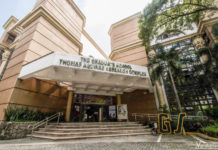
POLISH President Karol Tadeusz Nawrocki delivered a speech at the University of Santo Tomas on Wednesday, Oct. 7, during his state visit to the Philippines, the first by a sitting Polish president to the country.
Addressing University officials, students and staff, Nawrocki discussed the historical and contemporary ties between Poland and the Philippines, focusing on their shared religious heritage, struggles for freedom and sovereignty and commitment to international law and a peaceful international order.
Read the full text of his speech below:
Distinguished Authorities of the University of Santo Tomas,
Excellencies, Dear Students and Staff of the University,
It is a great pleasure and honour to be here at the University of Santo Tomas during my official visit to the Philippines – a country thousands of kilometres from Poland, yet increasingly close to us in values, interests and ambitions. I am grateful for the invitation and honoured to speak to you today about my homeland: Poland, our history, our achievements, and our vision of the world today.
We meet at a time when developments in Europe and Southeast Asia are increasingly interconnected, and when our two countries have both the opportunity and the responsibility to contribute to a more secure, stable and prosperous world. My visit – the first official visit to the Philippines by a President of Poland – is a clear sign of our commitment to building that partnership.
Dear Students, Dear Friends, Dear Excellencies,
My lecture will look at our relationship from two connected perspectives: the historical and the contemporary. The common thread is the values, experiences and interests we share. Because whether we speak about the past, the present or the future, lasting partnerships are built on what people and nations have in common. So let me begin with two themes that have shaped both our nations and continue to influence our relationship today: faith and freedom.
Although Poland and the Philippines are separated by thousands of kilometres, religion plays an important role in both our societies. Catholicism has helped to shape our values, strengthening our attachment to family, solidarity, responsibility and care for others.
Our first Polish links with the Philippines came through the Church. Polish missionaries were present here as early as the seventeenth century. Among them was Father Wojciech Męciński, a Jesuit from Kraków, believed to have been the first Pole to visit the Philippines.
Perhaps the most important figure connecting our two nations is Saint Pope John Paul II. He visited the Philippines twice, in 1981 and 1995. His second visit coincided with the first World Youth Day held in Asia, here in Manila — a powerful reminder of the role young people play in shaping the future. I know that he also visited this university, and I am proud to see how deeply you continue to remember and honour his legacy.
We also proudly remember figures such as Nicolaus Copernicus, whose groundbreaking work, On the Revolutions of the Heavenly Spheres, is represented here by a copy kept in the UST Library. The achievements of Polish and Filipino scientists and cultural figures — from Maria Skłodowska–Curie and Fryderyk Chopin to Gabriel Fahrenheit, who was born in my hometown of Gdańsk, and José Rizal — are part of our shared heritage.
But our connection goes beyond religion, science and culture. There is another experience that strongly connects Poland and the Philippines: the struggle for freedom and sovereignty. Both our nations know what it means to face foreign domination while preserving national identity and the right to determine our own future.
In Poland’s case, our state disappeared from the map of Europe for 123 years following partitions by neighbouring powers, including Russia, after 1795. Yet the Polish nation survived through its language, culture, religion and determination to remain free. After the Second World War, Poland again found itself under communist rule and Soviet domination.
The breakthrough came with the Solidarity movement, which united millions of Poles around the ideals of freedom, dignity and democratic change. Its success helped transform Poland and Central and Eastern Europe.
The Philippines, too, experienced long periods of foreign rule. These experiences shaped Filipino society and statehood, but also strengthened the determination of Filipinos to preserve their identity and chart their own course.
These shared experiences help explain why freedom, sovereignty and national independence hold such a special place in both our nations. For Poles and Filipinos, sovereignty, territorial integrity and the right of nations to determine their own future are not abstract concepts. They are fundamental values that we defend and uphold.
It is therefore natural that Poland and the Philippines share a strong commitment to international law and to a peaceful international order based on the UN Charter. Aggression, coercion and threats cannot be legitimate instruments of foreign policy or means of expanding spheres of influence. We have a shared responsibility to speak clearly against actions by any state that violate the sovereignty or territorial integrity of another country — whether in Europe, Asia or anywhere else in the world. This is one of the foundations on which our partnership has been built — and one that remains highly relevant today.
Dear Excellencies, Dear Students, Dear Friends,
Let me say a few words about the current situation in Europe and about Russia, which Poland considers the greatest threat to its security and sovereignty.
For Poles, Russia’s aggression against Ukraine is not an isolated event. Our historical experience with Russia — both imperial and Soviet — has been marked by domination, coercion and repeated violations of the rights of other nations. Today, Russia is waging a full–scale war against Ukraine while conducting hybrid attacks against Poland and other European countries through disinformation, cyberattacks and sabotage.
Poland’s response is clear: deterrence requires strength. That is why, as a committed NATO ally and close security partner of the United States, we are investing heavily in defence and strengthening our military capabilities.
The Philippines faces its own security challenges, particularly in the maritime domain. Actions that undermine sovereign rights, threaten freedom of navigation or endanger critical infrastructure can destabilise entire regions and disrupt global trade.
That is why Poland strongly supports the peaceful resolution of disputes in accordance with international law. We understand the importance of maritime security because we face similar challenges in the Baltic Sea, affecting transport, energy infrastructure and supply chains.
Despite our different geographies, many of our concerns are remarkably similar. This creates a strong basis for deeper cooperation. By sharing experience, technology and expertise, our countries can strengthen resilience and contribute to security in both the Indo–Pacific and Euro–Atlantic regions.
But our cooperation is not only about security. Security creates the stability in which development, trade and investment can flourish. Poland’s transformation is a good example. Since 1990, our GDP per capita has more than tripled, while exports have grown nearly thirty–fold.
Today, Poland is the EU’s sixth–largest economy, the largest in Central and Eastern Europe, and one of the world’s twenty largest economies. Deeply integrated into the European Single Market and global supply chains, Poland has become a European success story.
The Philippines is also a dynamic and rapidly developing economy, and a gateway to the ASEAN market. Its greatest strength is its people – a young, creative and well–educated population. The economy grew by 4.4% in 2025, creating opportunities across many sectors.
But our stories are about more than statistics. They are stories of resilience, ambition and hard work. Poland sees that potential in the Philippines — and so do Polish entrepreneurs. That is why such a strong business delegation has joined me on this visit: we believe there is a great deal we can achieve together.
Dear Students, Dear Friends,
Let me now turn to another dimension of our partnership: the role that Poland and the Philippines can play in regional and global affairs.
Both our countries have achieved significant progress in recent decades. As a result, we are increasingly expected not only to benefit from the international system, but also to help shape it. As dynamic middle powers, we may come from different regions, yet we share an interest in stability, cooperation and a stronger voice for countries that are not always adequately represented in global debates.
This is particularly relevant as the Philippines chairs ASEAN this year under the theme “Navigating Our Future, Together.” With the support of the Philippines, we recently joined the Treaty of Amity and Cooperation in Southeast Asia. This reflects Poland’s long–term commitment to Southeast Asia and our intention to deepen cooperation with ASEAN and its member states. We see ASEAN as one of the world’s most important regional organisations and a key contributor to stability, growth and dialogue in the Indo–Pacific.
At the same time, Poland is becoming more active in global affairs. This year, we are participating in the work of the G20, and I will attend the Summit in Miami. We want to bring to this forum the perspectives of countries and regions that have too often been underrepresented in global debates. We believe that a stronger voice for emerging and dynamic regions can make the international system more responsive to the realities of today’s world.
In this sense, Poland and the Philippines share a similar ambition. By working together, we can contribute to a more inclusive, balanced and representative international order. That is why I see Poland’s closer engagement with ASEAN, and our growing partnership with the Philippines, not only as an opportunity for our two countries, but also as a contribution to stronger cooperation between our continents.
Dear Students, Dear Filipino Friends of Poland,
Let me conclude by addressing you directly.
You, the students — young, talented and ambitious — are the future of the Philippines and an important part of the future of Polish–Philippine relations. Our partnership is built on people.
This morning, at the Polish–Philippine IT Business Summit, I met young Filipino software developers competing in the Hackathon and creating everyday solutions for smart cities. Now I have the privilege of speaking to you—students of this distinguished university, future lawyers, economists, politicians and historians.
You are well placed to become natural ambassadors of Polish–Philippine relations. Visit Poland. Build friendships. Strengthen the connections between our societies. Because we, as leaders, can open doors, but lasting relationships are built by people.
As Saint Thomas wrote “Charity, by which God and neighbor are loved, is the most perfect friendship”. Although the Philippines remains geographically distant to Poland, we indeed treat you like close neighbors and perfect friends.
And let me assure you that your contribution to this friendship matters. Thank you.