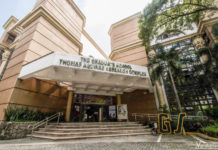
TWO THOMASIAN Supreme Court justices warned against the misuse of public funds in separate opinions accompanying a ruling that struck down unconstitutional appropriations in the 2024, 2025 and 2026 national budgets.
Associate Justices Amy Lazaro-Javier and Ramon Paul Hernando concurred in the ruling but expressed some reservations about the majority decision penned by Senior Associate Justice Marvic M.V.F. Leonen, particularly on the treatment of unprogrammed appropriations and safeguards against their misuse.
The Supreme Court en banc ruled on Oct. 20 that unprogrammed appropriations, or standby funds that may be released under specified conditions, are not unconstitutional in themselves. However, it barred Congress from increasing the total national budget proposed by the President and imposed stricter conditions on the release of unprogrammed funds.
The 121-page ruling invalidated congressional budget increases involving P449.5 billion in unprogrammed appropriations in the 2024 General Appropriations Act (GAA) and a P17.99-billion increase involving the Department of Public Works and Highways’ Special Road Fund in the 2025 GAA.
The Court also struck down provisions in the 2026 GAA that allowed the release of unprogrammed funds based on excess collections from individual non-tax revenue sources.
“The SC ruled that Unprogrammed Appropriations are not unconstitutional per se. However, this budgetary item needs clear limits and safeguards to preserve fiscal discipline, transparency, and accountability,” the Court said in a statement.
Lazaro-Javier: Budget ceiling must be upheld
In her concurring and dissenting opinion, Lazaro-Javier argued that unprogrammed appropriations in the three GAAs exceeded the spending ceiling set by President Ferdinand Marcos Jr. in his proposed national budgets.
She maintained that Congress could not circumvent the constitutional prohibition against increasing the President’s proposed appropriations by adding contingent funds that could be released later.
“When the legislature inflates standby and special funds beyond this Constitutional limit and strips away the checks guarding their release, it transforms a contingent safety valve into an unchecked vault, subverting the constitutional architecture,” Lazaro-Javier said.
Lazaro-Javier also questioned the application of the doctrine of operative fact, which allows certain consequences of an unconstitutional government action to remain legally effective.
She argued that the use of the affected funds should first be fully accounted for before the Court determines whether the doctrine should apply.
“Because the doctrine rests on equity, its application cannot be divorced from the specific facts to which it is applied,” she said.
Hernando: Unprogrammed appropriations should be prohibited
In his separate opinion, Hernando took a more restrictive position, arguing that unprogrammed appropriations should not be included in the GAA.
He disagreed with the majority’s decision to uphold their constitutionality in principle, warning that such funds could facilitate corruption and political patronage.
Hernando described unprogrammed appropriations as “definite sources of graft and corruption in the government” that undermined safeguards against the misuse of public funds.
“In validating the existence of UAs within the framework of the Constitution, the majority ruling of the Court has unfortunately missed an opportunity to decisively fling to the trash bin (balde ng basura) this unconstitutional monstrosity and to fortify and solidify good governance in public expenditures,” he said.
Hernando argued that excess or additional government revenues should instead be allocated through a separate special appropriations law, rather than through unprogrammed appropriations in the annual GAA.
“Excess or new revenue collections generated cannot be left to the unbridled discretion of the Legislature in the exercise of its spending powers but must lawfully be directed towards the nation’s priority projects and programs,” he said.
The Supreme Court’s decision resolved petitions challenging provisions of the three national budgets.
It granted the petition of the late lawmaker Edcel Lagman and partially granted that of former senator Aquilino “Koko” Pimentel III, which questioned the increase in unprogrammed appropriations in the 2024 GAA.
The Court also granted the petition of civil society group Filipinos for Peace, Justice and Progress Movement Inc. concerning the 2025 GAA and partially granted the petition of lawmakers Leila de Lima and Edgar Erice challenging provisions of the 2026 GAA.
Lazaro-Javier graduated as class valedictorian from the UST Faculty of Civil Law. She received the 2024 TOTAL Award for Law and Judiciary from the UST Alumni Association and chaired the 2025 Bar Examinations, for which UST served as a national headquarters and testing center.
Hernando graduated from UST with a Bachelor of Arts in Literature in 1986. He briefly attended the UST Faculty of Civil Law before completing his law degree at San Beda.